 RevPulse
Etsy competitor research: find product gaps in 1–3★ reviews
A best-selling Etsy listing with hundreds of reviews is a free focus group. The 5★ reviews tell you what buyers came for. The 1–3★ reviews tell you what the seller keeps getting wrong – and that is the gap you can fill. This guide shows a repeatable way to do it in under an hour per competitor.
1. Pick 3–5 competitors worth studying
Search Etsy for the product you sell or plan to sell. Pick listings with lots of reviews (at least 100) and a rating that isn't perfect – a 4.6–4.8 average usually hides a few clear, fixable problems. Mix one big shop with a couple of mid-sized ones.
2. Export their reviews
Open each listing, open RevPulse, set the filter to Pain Points Only (1–3★) and click Extract. You get the low-star reviews with their date, variation and the seller's reply. Export CSV (or Copy for Excel) and put each competitor on its own sheet tab. The free version covers 50 reviews per scan, which is usually every low-star review on a mid-sized listing. (Full export guide.)
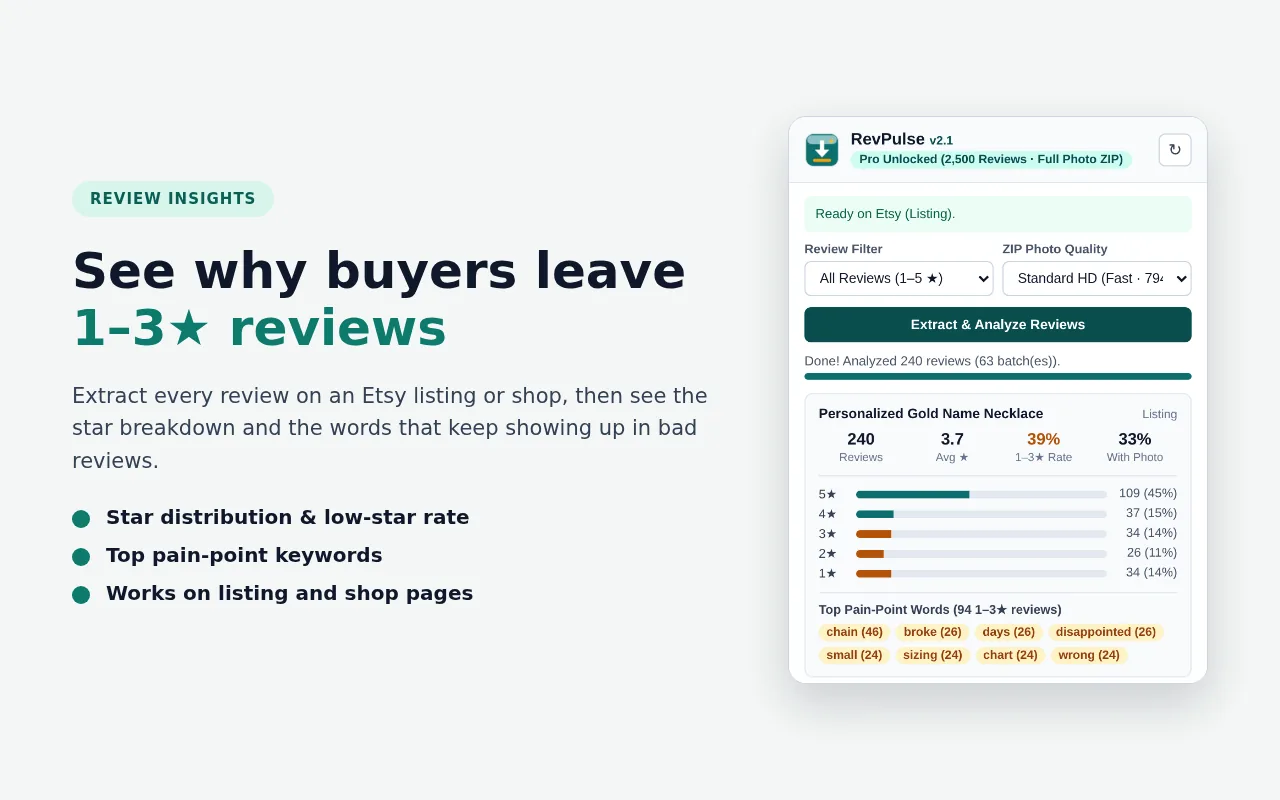
3. Read the pain-point words first
Before reading anything, look at RevPulse's Top Pain-Point Words. In the example above, a personalized necklace with a 3.7★ average shows chain, broke, sizing, chart, small, wrong, days. That already sorts complaints into three buckets: the chain breaks, the size chart misleads, and shipping takes too long.
Also note the 1–3★ rate. A listing where 39% of reviews are 1–3★ has a structural problem, not bad luck.
4. Tag each complaint
Add a column called Issue and give every low-star review one tag. Keep the list short:
- Quality – broke, tarnished, peeling, stitching
- Size / fit – too small, chart wrong, didn't fit
- Not as pictured – color off, smaller than photo
- Personalization – typo, wrong font, missing name
- Shipping / packaging – late, crushed, lost
- Service – no reply, refused refund
Use the Variation column too: if most complaints are about one size or one material, that variation is the weak spot.
5. Count and rank
A pivot table (or COUNTIF) on the Issue column gives you a ranked list per competitor. Put them side by side. Problems that show up across several shops are category problems – the best opportunities, because buyers will notice a listing that clearly solves them.
6. Let AI do the first read (optional)
RevPulse has a Copy Prompt button that bundles up to 150 reviews (lowest rating first) with instructions, ready to paste into ChatGPT, Claude or Gemini. The "Competitor Defects & Fixes" prompt looks like this:
You are an e-commerce product strategist. Analyze these Etsy customer reviews for "[product]".
Output:
1. Top 5 recurring buyer complaints, defects, or packaging/shipping failures
2. Top 5 features buyers love most
3. Concrete product, variation, and listing improvements to outperform this competitor.

Reviews:
[paste reviews here, lowest rating first]
Treat the answer as a first draft. Check every claim against the actual reviews – AI summaries can overstate a complaint that appears twice.
7. Turn findings into changes
| Complaint pattern | What you change |
|---|---|
| "Chain broke in a week" | Upgrade the component, then say so in the title photo and first bullet |
| "Smaller than expected" | Add a photo with a ruler or on a model, and a clear size chart |
| "Wrong name / typo" | Add a proof step or a "type it exactly" note in personalization |
| "Took 3 weeks" | Realistic processing time, tracked shipping, a holiday cut-off date |
| "Arrived crushed" | Better packaging – and show it in a listing photo |
Also read the shop replies. A competitor who answers every 1★ review with the same excuse is telling you their buyers' objection, and their best defense against it.
Bonus: mine the 4–5★ reviews for your copy
Switch the filter to Positive Only (4–5★) and use the "Winning Angles & Ad Copy" prompt. Buyers' own words ("looks way more expensive than it is", "my mom cried") make better listing bullets than anything you'd write yourself.
Try RevPulse free
The free version exports 50 reviews and 10 buyer photos per scan, no sign-up. Upgrade to Pro ($19 one-time) when you need more.
EARLYBIRD (normally $19 · first 30 buyers · until Dec 31, 2026).